In a nutshell
- 🧠 Memory anchoring ties information to vivid cues, leveraging encoding specificity and pattern completion to make recall faster and more reliable.
- 🎨 Multisensory strategies—dual coding, imagery, rhythm, emotion—counter the Ebbinghaus forgetting curve by creating multiple pathways back to the same memory.
- 🧭 Practical anchors include sensory (scents), spatial (method of loci), auditory (beats), emotional (stories), and gesture cues, selected for consistency and easy reproduction.
- 🏛️ Real-world payoffs span exams, courtrooms, newsrooms, and boardrooms, where anchors externalise structure, steady attention under pressure, and cut retrieval time.
- 🔁 Build and test anchors with retrieval practice, the spacing effect, context rehearsal, and simple performance logs—then prune to a small, dependable set.
Memory isn’t a dusty archive; it’s a living system that favours patterns, places, smells, and stories. That’s why memory anchoring—deliberately tying information to a vivid cue—can elevate recall from hit-and-miss to reliable and swift. In newsrooms, lecture halls, and courtrooms, the difference is stark. A single song can resurface an entire summer. A scent can resurrect a scene. The magic lies in how well the brain binds details to contexts that can be re-summoned on demand. Done well, anchoring compresses revision time, boosts confidence, and cuts the mental noise that sabotages performance under pressure.
The Science Behind Memory Anchoring
At its core, memory anchoring leverages the brain’s bias for associations. The hippocampus doesn’t store isolated facts; it maps relationships. When you tether a formula to a sound, a date to a place, or a name to a striking image, you’re exploiting encoding specificity: the idea that recall improves when the retrieval context mirrors the encoding context. Change the context, and the memory can vanish; recreate it, and it snaps back into focus. That’s not mysticism. It’s pattern completion—a neural network reactivating a stored pattern from a partial cue.
Anchors also work through dual coding and multisensory integration. Words alone fade fast on the Ebbinghaus forgetting curve. Words plus imagery, location, rhythm, or emotion carve deeper traces. Novelty sparks dopamine, which marks an experience as important. So we stack cues: a bright mental picture, a distinctive place in a method of loci, and a short phrase with internal rhyme. The brain loves redundancy. It offers multiple doors back into the same room, so if one cue fails, another opens. The result is reliable access, even when stress narrows attention.
Practical Anchors You Can Deploy Today
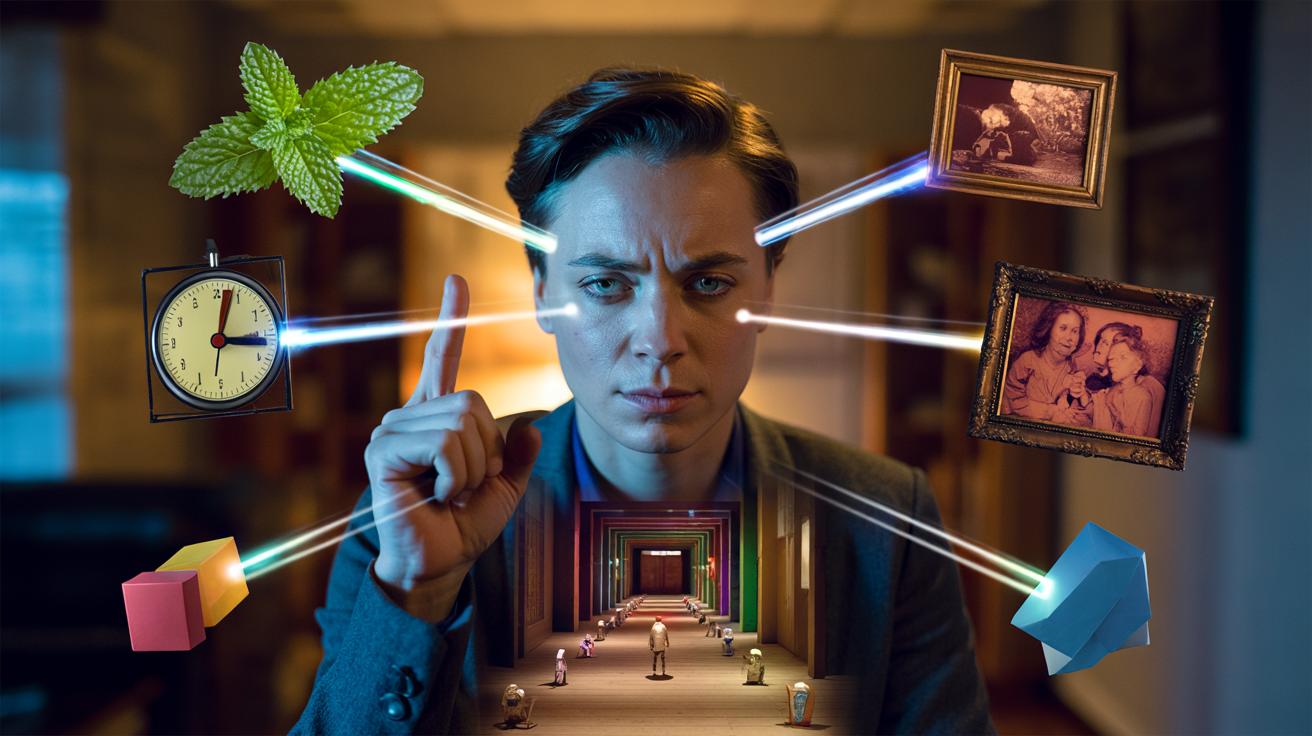
Think in senses. A sensory anchor could be a specific peppermint when revising, then the same during the exam, reinforcing state-dependent recall. A spatial anchor places each concept along a familiar route—the hallway, the bus stop, the corner shop—so a quick mental walk retrieves points in order. Sequence becomes scenery, and ideas become landmarks. Emotional anchors also pack a punch: bind dry data to a personal story, a sharp contrast, or a quirky image that makes you grin. If it moves you, it will likely stay.
Consistency multiplies the effect. Use a recurring cue phrase before presenting numbers. Create a gesture anchor—a subtle finger tap—during learning, repeat it when recalling. Add a simple rhythm or beat to lists, because prosody aids chunking. To decide what to use, pick cues you can reliably reproduce across contexts, not ones reliant on rare environments. Below is a compact guide for choosing the right anchor at the right time.
| Anchor Type | Example Cue | Best Use | Recall Boost Tip |
|---|---|---|---|
| Sensory | Peppermint aroma | Facts, definitions | Match scent during retrieval |
| Spatial | Method of loci | Ordered lists | Use vivid, absurd imagery |
| Auditory | Short rhythm | Sequences, steps | Keep beat distinctive |
| Emotional | Personal story | Abstract ideas | Tie to stakes or humour |
| Gesture | Finger tap | High-pressure recall | Practise with spaced tests |
From Exams to Boardrooms: Real-World Payoffs
Students anchor tricky equations to a kitchen route—sink, hob, kettle—then “walk” it in the exam, retrieving steps in order. Barristers map witness timelines onto courtroom features and prompt recall by glancing left to right, reconstructing sequences without notes. When the stakes rise, anchors steady the mind and cut retrieval time. Journalists remember names at crowded briefings by linking faces to distinctive objects—hat, badge, bag—and a single descriptive word, ticking through the objects as conversations shift.
Managers use anchor phrases to present quarterly results: “Three levers, one outcome,” then tie each lever to a colour on a slide and a position on stage. The room becomes a mnemonic scaffold. Medics rehearse emergency protocols with auditory anchors—a three-beat cadence for drug dosages—so that stress triggers the rhythm, not panic. The common thread is not talent but design. Anchors externalise structure, making the invisible architecture of information visible, tactile, and repeatable across settings, even when distractions pile in.
How to Build and Test Your Anchors
Start by selecting the material that must not fail—figures, names, dates, core arguments. Choose one primary anchor and one backup. Pair, for instance, a spatial route with a cue phrase. Then encode deliberately: exaggerate imagery, add colour and motion, and make interactions unexpected. The weirder the better. Distinctiveness is insurance against interference. Next, rehearse using retrieval practice: test yourself cold, in short bursts, rather than rereading. Each successful pull strengthens the link between anchor and memory, while failures teach you where to refine.
Schedule sessions with the spacing effect, increasing intervals—1 day, 3 days, a week—so the memory consolidates. Recreate retrieval contexts: stand, breathe, repeat the gesture you picked, and use the same rhythm. Then scramble it. Change rooms, chairs, times of day, so the anchor proves resilient. Track outcomes with a simple log: time to recall, errors made, confidence rating. Adjust imagery or cues where recall lags. Finally, prune. Too many anchors cause clutter. Keep a small, dependable set you can trigger instantly under pressure, and let repetition make them automatic.
Memory anchoring is not a parlour trick; it’s a practical craft that respects how the brain prefers to work—through associations, contexts, and stories. With a few minutes of design, you can turn revision into rehearsal, meetings into performances, and data into scenes that linger. The right cue at the right moment can collapse hesitation into clarity. The question is no longer whether anchoring works, but which anchors fit your goals, your environment, and your temperament. So, which anchor will you trial this week—and how will you measure the difference it makes?
Did you like it?4.7/5 (22)